
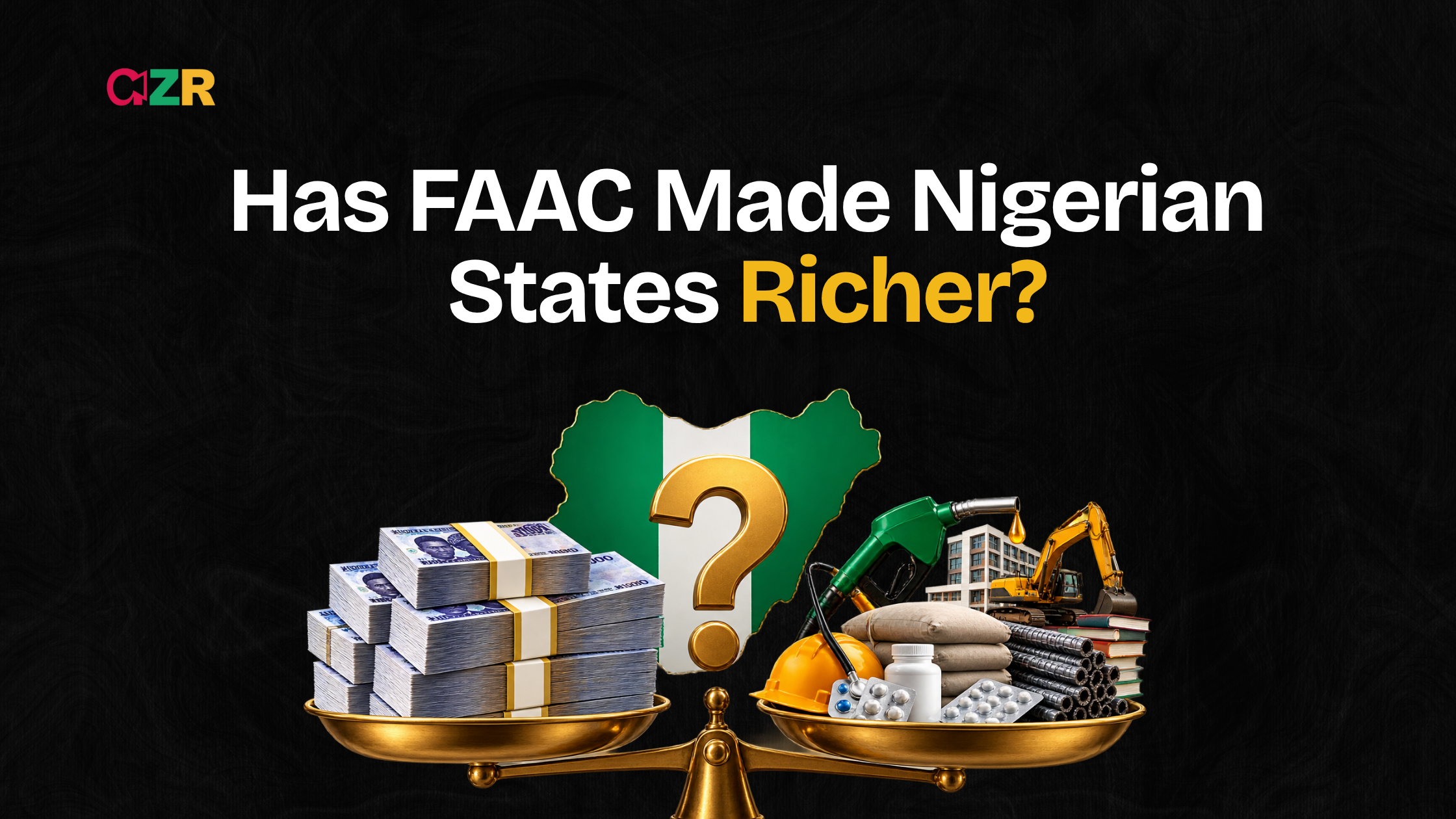
One figure the President Tinubu administration frequently points to when making the case for its economic reforms is the historic increase in Federation Account Allocation Committee (FAAC) disbursements. Since the removal of the petrol subsidy and the shift towards a more market-driven foreign exchange system in mid-2023, FAAC distributions to Nigeria’s states and local governments have risen sharply. On paper, state governments are receiving more naira than ever before. But does a larger allocation automatically mean greater fiscal capacity?
To answer that, we need to look beyond the headline figures: what is driving the increase, what that money can actually buy, and what states are doing with it.
Surging FAAC allocations have delivered record volumes of Naira to states.
Source: Richard Darko / Getty Images
The Revenue Jump
There is little doubt that states are receiving substantially more money. According to the Nigeria Extractive Industries Transparency Initiative (NEITI), total net FAAC distributions to the three tiers of government rose from ₦10.09 trillion in 2023 to ₦15.26 trillion in 2024 – a 43% increase. BudgIT’s analysis of subnational finances records an even larger jump in gross FAAC received by states, from ₦5.4 trillion in 2023 to ₦11.38 trillion in 2024; this is more than double. Furthermore, FAAC accounted for 66% of the increase in the combined revenue of the 35 states assessed.
The figures are not directly comparable. NEITI’s figure covers the three tiers of government and uses net distributions, while BudgIT’s focuses on gross allocations to states. But they point in the same direction: the amount of nominal naira flowing to states has increased sharply. So, what is behind the jump?
- Exchange Rate Effects: Nigeria earns significant government revenue in US dollars, particularly from crude oil. When the naira loses value, those dollar earnings convert into more naira. The same dollar revenue can therefore produce a much larger allocation in naira terms.
- Subsidy Removal: The removal of the petrol subsidy in 2023 also significantly altered the government’s fiscal position. Money that had previously been absorbed by petrol subsidy payments was no longer being spent in the same way. This changed the resources available within the federation’s fiscal framework and contributed to the amount available for distribution among the federal, state and local governments.
- Higher VAT Collections: VAT collections have also risen. But higher prices mean more naira is collected even when Nigerians are not necessarily buying more. A bigger VAT figure, therefore, does not automatically mean a richer economy.
The headline numbers tell us that states have more naira. They do not yet tell us what that naira is worth.
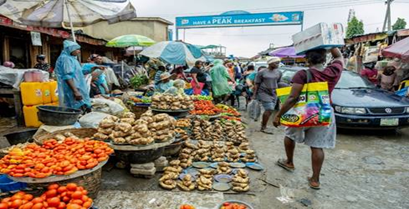
Market prices dictate the real value of state allocations.
Source: Bloomberg / Bloomberg via Getty Images
The Irony of More Naira
While allocations have grown, the naira’s purchasing power has fallen sharply. Headline inflation reached 34.80% in December 2024, according to the National Bureau of Statistics (NBS). The cost of everyday goods rose alongside it. The SBM Jollof Index offers a simple illustration. A pot of jollof rice for a family of five cost ₦10,881 in March 2023. By March 2024, it cost ₦16,955, a 55.8% increase. By June 2025, the cost had reached ₦27,527.85, 153% higher than in March 2023.
| Time Period | Cost of a Pot of Jollof | % Increase (from Mar 2023) |
|---|---|---|
| March 2023 | ₦10,881 | – |
| March 2024 | ₦16,955 | +55.8% |
| June 2025 | ₦27,527.85 | +153.0% |
State governments are executing their capital and recurrent budgets within this same inflationary environment.
The Jollof Index is not a direct measure of government purchasing power. It does, however, illustrate the wider inflationary environment in which state governments have been operating. If the cost of food, construction materials, fuel, transportation, equipment and other inputs rises sharply, an increase in nominal government revenue does not necessarily translate into an equivalent increase in what that revenue can accomplish.
Where Is the Money Going?
The next question is what states are doing with the additional revenue. BudgIT found that combined expenditure across the 35 states assessed increased by 64.69% in 2024. Personnel expenditure rose by 23.24%, overhead by 62.66%, and capital expenditure by 87.93%. The rise in capital spending is particularly significant. It increased from ₦4.06 trillion in 2023 to ₦7.63 trillion in 2024, exceeding recurrent spending for the first time in the period covered by the report. That suggests some of the additional revenue is reaching roads, infrastructure and other development projects. But spending more does not automatically mean getting more. Education provides one example. States budgeted ₦2.41 trillion for education in 2024 but spent ₦1.61 trillion, about 66.9% of the budget. Health spending showed a similar gap: ₦1.32 trillion was budgeted, but ₦816.64 billion was spent, representing 61.9% implementation. When you spread that spending across millions of citizens, the numbers become smaller. Average education spending among the states assessed was ₦6,981 per person. For health, it was ₦3,483.
These figures do not tell us whether public services improved or worsened. They do show that more revenue does not automatically translate into more services delivered. But another question remains: how much of this new revenue are states generating themselves? BudgIT found that 31 of the 35 states assessed relied on federal transfers for at least 80% of their recurrent revenue in 2024. That does not mean the states are worse off. But it shows that receiving more money through FAAC is not the same as becoming more financially independent. For many states, a large share of their spending power still depends on revenue collected and distributed at the federal level. And that leaves us with a more useful way to think about the question.
So, Are Nigerian States Richer?
One part of the answer is clear: Nigerian states are receiving substantially more naira through FAAC than they did before 2023. That increase has given states room to spend more, including a significant rise in capital expenditure. But the size of the allocation tells only part of the story. The naira has lost value. The cost of running government has risen. Some budgets are not fully implemented. And many states remain heavily dependent on federal transfers. The question, therefore, should not simply be: “How much more money are Nigerian states receiving?” It should be: “How much more can Nigerian states actually do with the money they receive?” That is the difference between having more naira and having greater fiscal capacity. FAAC has undoubtedly given states more naira. Whether it has given them proportionately more fiscal capacity is a different question.
Sources
- BudgIT. (2024). State of States / Subnational Expenditure Analysis. BudgIT
- BusinessDay. (2024). Federation Account allocations soared by 43% in 2024 — NEITI.
- National Bureau of Statistics (NBS). (2024). Consumer Price Index – December 2024. NBS
- Nigeria Extractive Industries Transparency Initiative (NEITI). (2025). FAAC Quarterly Review 2024. Retrieved from NEITI Publications.
- Premium Times. (2024). Cost of preparing jollof rice up 29.3% — report. Premium Times.
- SBM Intelligence. (2024/2025). The SBM Jollof Index: The crushing cost of a pot. SB Morgen.
- The PUNCH. (2024). FAAC bonanza: Nigeria’s fiscal paradox. Punch.ng.